

Chinese Neurosurgical Journal Highlights Eosinophils as a Potential Target in Chordoma Treatment
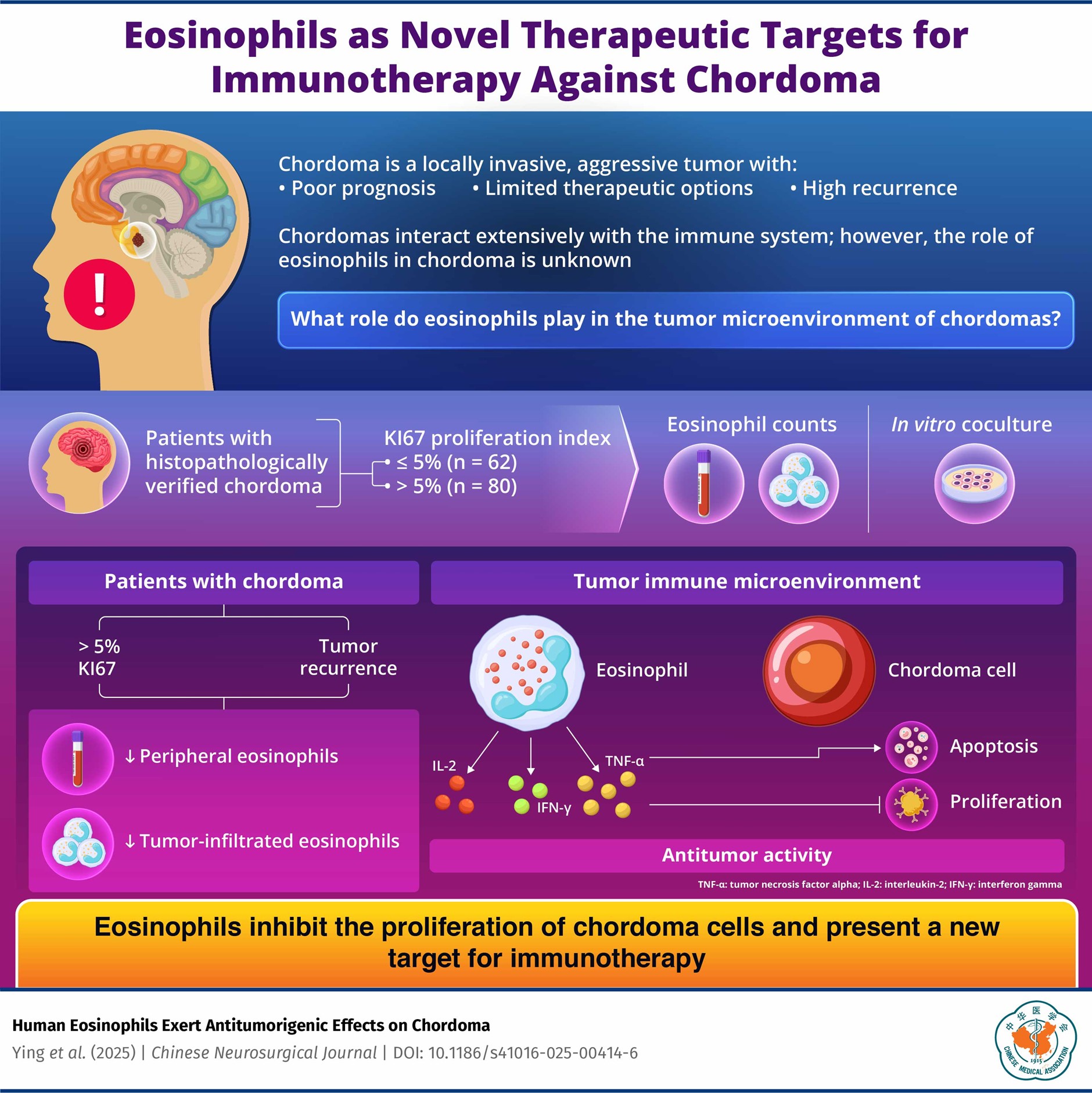
Comparison of eosinophil distribution and antitumor activity in chordoma, illustrating associations between eosinophil levels, Ki-67 proliferation index, tumor recurrence, and eosinophil-mediated cytokine-induced apoptosis of chordoma cells.
Researchers reveal that eosinophils suppress chordoma growth, highlighting its potential as an immunotherapeutic target
BEIJING, CHINA, January 30, 2026 /EINPresswire.com/ -- Chordoma is a rare tumor characterized by poor prognosis, limited therapeutic options, and a high rate of recurrence. Despite advances in oncology, effective treatments for chordoma remain limited. Resistance to conventional radiotherapy and chemotherapy restricts therapeutic options, and surgical treatment is often challenging due to the tumor’s proximity to critical anatomical structures. Consequently, identifying novel therapeutic targets is essential for improving chordoma diagnosis, treatment strategies, and outcome prediction.In recent years, the tumor immune microenvironment has emerged as a key area of research for understanding tumor development, recurrence, and therapeutic resistance. Chordomas are known to interact extensively with the immune system. Although eosinophils are recognized for their ability to regulate immune responses through cytokine secretion and interactions with other immune cells, their role in chordoma has remained largely unexplored.
In an effort to bridge this knowledge gap, a team of researchers led by Professor Liu Pinan of the Beijing Neurosurgical Institute, Capital Medical University, Beijing, China, and Dr. Wang Bo of Beijing Tiantan Hospital, Capital Medical University, Beijing, China—along with collaborators from Beijing Tiantan Hospital, Shandong Second Medical University, and Beijing Tsinghua Changgung Hospital—investigated the role of eosinophils—key immune cells—in chordoma. Their study was published in Volume 11, Issue 32 of the Chinese Neurosurgical Journal on 12 December 2025.
To examine the relationship between eosinophils and chordoma progression, the researchers analyzed clinical data from 142 patients with histopathologically confirmed chordoma and available Ki-67 proliferation index data, a commonly used marker of tumor cell proliferation. Patients were classified into two groups based on Ki-67 levels to compare differences in tumor proliferative activity. The analysis revealed a clear inverse relationship between eosinophil levels and tumor aggressiveness.
Prof. Pinan emphasizes, “Our results show that peripheral eosinophil and tumor-infiltrated eosinophil counts decreased with increasing Ki-67 proliferation index. Additionally, in a subset of patients, we noticed a decrease in peripheral eosinophil counts after tumor recurrence, indicating an association between eosinophil levels, tumor proliferation, and disease recurrence.”
To further understand whether eosinophils directly influence chordoma cells, in vivo coculture experiments were performed using human eosinophils cocultured with a human chordoma cell line. The findings provided functional evidence that eosinophils actively suppressed chordoma cell growth, supporting the observation that lower eosinophil counts are associated with more aggressive disease.
Dr. Bo explains, “Eosinophils seem to exert this effect by inducing cell death in tumor cells. When exposed to eosinophils, chordoma cells display higher levels of apoptosis or cell death, and this apoptotic response seems to increase as the number of eosinophils increases, indicating a direct and dose-dependent cytotoxic effect.”
Further molecular analyses revealed elevated levels of inflammatory cytokines, particularly tumor necrosis factor alpha (TNF-α), in the coculture system. Blocking TNF-α activity with neutralizing antibodies significantly reduced eosinophil-induced apoptosis, highlighting the central role of TNF-α in mediating tumor cell death.
Overall, the findings demonstrate that eosinophils play a critical role in suppressing chordoma proliferation. Lower eosinophil levels were associated with higher tumor proliferative activity and recurrence, while functionally active eosinophils directly inhibited tumor growth through cytokine-mediated apoptosis.
This study provides new insight into the immune mechanisms underlying chordoma progression and suggests that eosinophils may represent a novel immunotherapeutic target for this rare and difficult-to-treat tumor. Prof. Pinan concludes, “Our study offers a new direction for future research into treatment strategies for chordoma.”
Reference
Title of original paper: Human eosinophils exert antitumorigenic effects on chordoma
Journal: Chinese Neurosurgical Journal
DOI: https://doi.org/10.1186/s41016-025-00414-6
About Capital Medical University, Beijing
Capital Medical University (CCMU), founded in 1960, is a municipal public university in Beijing, China. It ranks among the top academic medical institutions in China, and is considered as one of the key municipal universities in Beijing. It is also listed as one of the top 300 universities in the world university rankings. CCMU provides a wide range of educational programs for Doctorates, Masters, Bachelors and certificates. CCMU is a well-known academic institution, known for its strong competence in the scientific research. It hosts many national and municipal key disciplines, laboratories and some exchange stations for post-doctoral research.
Website: https://ccmu.cucas.cn/
About Professor Liu Pinan from Capital Medical University, Beijing, China
Professor Liu Pinan is a neurosurgeon and researcher in the Department of Neurosurgery at Beijing Tiantan Hospital, Capital Medical University, Beijing, China. He holds a doctoral degree and has published over 120 research articles in areas including endoscopic neurosurgery, skull base surgery, and neurofibromatosis. His work focuses on advancing clinical and surgical approaches for the management of complex neurosurgical conditions. Professor Liu’s extensive contributions to both clinical practice and scientific research reflect his dedication to advancing neurosurgical knowledge and improving patient care.
About Dr. Bo Wang from Capital Medical University, Beijing, China
Dr. Bo Wang is affiliated with Beijing Tiantan Hospital, Capital Medical University, Beijing, China. He is an active researcher and has co-authored over 150 research articles. His research interests span arnold chiari malformation, encephalocele, hamilton anxiety rating scale, cell proliferation, mini-mental state examination, nerve sheath tumor, visual impairment, comparative genomics, cell proliferation, encephalocele, neurinoma, and meningioma research. Through his diverse research portfolio, he has contributed to understanding complex neurological disorders.
Funding information
The Public Welfare Development and Reform Pilot Project of Beijing Medical Research Institute [grant no. JYY 2023–2].
Yi Lu
Chinese Neurosurgical Journal
+861059978478 ext.
email us here
Visit us on social media:
Other
Legal Disclaimer:
EIN Presswire provides this news content "as is" without warranty of any kind. We do not accept any responsibility or liability for the accuracy, content, images, videos, licenses, completeness, legality, or reliability of the information contained in this article. If you have any complaints or copyright issues related to this article, kindly contact the author above.
