

Global Airborne ISR Market Value to Reach USD 14.51 Billion by 2034 | Industry CAGR 3.9% CAGR (2026-2034)
Airborne ISR Market
Market projected to grow from USD 10.65B in 2026 to USD 14.51B at 3.9% CAGR.
Airborne ISR is transitioning from standalone platforms to integrated, networked systems that deliver actionable intelligence with improved persistence and connectivity.”
PUNE, MAHARASHTRA, INDIA, February 8, 2026 /EINPresswire.com/ -- The global airborne intelligence, surveillance, and reconnaissance (ISR) market is poised for steady growth through the forecast period, driven by increasing defense and security requirements, according to a new research report published by Fortune Business Insights™. The market was valued at USD 10.25 billion in 2025 and is projected to grow from USD 10.65 billion in 2026 to USD 14.51 billion by 2034, exhibiting a compound annual growth rate (CAGR) of 3.9% during the forecast period.— Fortune Business Insights
Get a Free Sample PDF - https://www.fortunebusinessinsights.com/enquiry/request-sample-pdf/airborne-isr-market-105529
Airborne ISR systems — which include airborne platforms equipped with sensors and mission systems for intelligence collection, real-time surveillance, and reconnaissance — play a crucial role in enhancing situational awareness across land, air, and maritime domains. These systems combine electro-optical/infrared (EO/IR) imaging, radar technologies such as synthetic aperture radar (SAR) and ground moving target indicator (GMTI), and signals intelligence (SIGINT) payloads to support wide-area monitoring, target detection, tracking, and command-and-control functions.
The market’s growth is underpinned by rising demand for persistent surveillance capabilities and faster data delivery to support modern defense and coalition operations. As military missions grow more joint and networked, interoperable ISR systems that share standardized data across platforms and services are increasingly prioritized by defense forces worldwide.
A continuing shift toward modular mission systems — which allow sensors, onboard processing, and communications payloads to be upgraded without extensive aircraft redesign — is also shaping the market. This trend enables defense customers to refresh ISR fleets via incremental upgrades rather than relying solely on new aircraft purchases, increasing operational flexibility and lowering acquisition risk.
Market Drivers and Growth Factors
One of the central drivers of airborne ISR market expansion is the rising need for enhanced situational awareness across wide operational theatres. Persistent surveillance systems allow defense and homeland security agencies to detect and classify threats early, maintain custody of tracks, and support rapid decision cycles, which are critical in both peacetime and conflict environments.
Modern electronic warfare environments present additional impetus for investment in airborne ISR. As adversaries employ jamming, spoofing, and contested electromagnetic conditions, defense forces require resilient mission systems with hardened communications and onboard processing capabilities that maintain utility even when external connectivity degrades.
The increasing complexity of coalition and joint operations also drives demand for interoperable ISR systems that can integrate seamlessly into broader command-and-control architectures. Standardized data sharing and secure connectivity help align ISR outputs with operational workflows across allied forces, reinforcing the strategic importance of airborne ISR in multinational operations.
Get a Free Sample PDF - https://www.fortunebusinessinsights.com/enquiry/request-sample-pdf/airborne-isr-market-105529
Market Restraints
Despite robust demand, the airborne ISR market faces challenges related to system integration complexity, lengthy certification processes, and export controls. Integrating sensors, mission computers, encryption systems, antennas, and data links into cohesive ISR capabilities requires careful engineering and software maturity to meet performance requirements, which can delay delivery schedules.
Certification and airworthiness testing — particularly for large unmanned aerial systems (UAS) and modified manned platforms — are time-intensive and extend beyond typical acquisition timelines. Export restrictions on advanced SIGINT or radar payloads further complicate procurement and slow international sales.
Supply-chain constraints for high-end electronics and sensors also act as bottlenecks in production, while complex contracting and sustainment requirements increase the logistical burden on both vendors and defense customers.
Market Trends
A prominent trend in the airborne ISR market is the shift toward modular, upgradeable mission systems. Rather than treating ISR platforms as fixed configurations, defense agencies are prioritizing open-architecture designs that support rapid sensor refresh, software improvements, and interoperability upgrades throughout the aircraft lifecycle.
Defense customers are also increasingly adopting multi-sensor fusion workflows that combine radar, EO/IR, and signals data into consolidated tracks and alerts, enhancing target discrimination and reducing false alarms in cluttered environments. This trend improves data relevance and reduces network bandwidth needs by prioritizing actionable intelligence over raw sensor streams.
Another trend is the evolution of distributed ISR operations, where manned special-mission aircraft, UAS, and maritime ISR platforms operate as integrated components of a broader intelligence network. This approach expands coverage and resilience while allowing assets with different strengths — long endurance, high-altitude persistence, or specialized payloads — to complement each other’s capabilities.
Market Segmentation
The report segments the airborne ISR market by end user, platform, solution, and application, reflecting diverse demand patterns across defense and security use cases.
By End User
The defense segment dominated the market in 2025 and is expected to maintain leadership through 2034, accounting for the largest share due to extensive military ISR requirements for tracking, targeting, force protection, battle-damage assessment, and operational planning. Homeland security applications are also growing, with agencies investing in airborne ISR for border surveillance and critical infrastructure protection.
By Platform
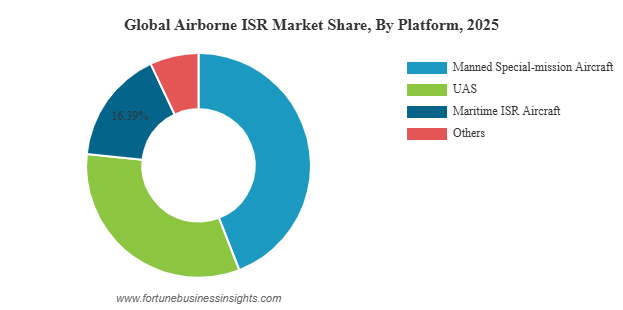
The manned special-mission aircraft segment held the largest share in 2025 and is projected to continue leading, owing to its ability to host heavy, power-hungry radar and SIGINT suites, support long missions, and integrate securely into classified networks. Unmanned aerial systems (UAS) are expected to grow at a notable rate over the forecast period, driven by demand for flexible, persistent ISR coverage with lower operational risk.
Request for customization -https://www.fortunebusinessinsights.com/enquiry/customization/airborne-isr-market-105529
By Solution
By solution category, systems — which include integrated sensor packages, mission computers, and data links — accounted for the largest portion of the market in 2025. Integrated systems reduce integration risk, speed upgrades, and improve interoperability, making them appealing in contested environments. The software segment, including analytics and command-and-control applications, is also forecast to grow as data processing and fusion become central to mission value.
By Application
Among applications, maritime patrol ISR held the largest share in 2025 and is projected to remain dominant. Maritime ISR missions support the detection and classification of contacts in exclusive economic zones and contested waters, requiring wide-area radar, EO/IR imaging, and long endurance platforms. Signals intelligence (SIGINT) operations are also expected to grow significantly as demand increases for electronic intercept and classification in complex threat environments.
Ashwin Arora
Fortune Business Insights™ Pvt. Ltd.
+1 833-909-2966
sales@fortunebusinessinsights.com
Legal Disclaimer:
EIN Presswire provides this news content "as is" without warranty of any kind. We do not accept any responsibility or liability for the accuracy, content, images, videos, licenses, completeness, legality, or reliability of the information contained in this article. If you have any complaints or copyright issues related to this article, kindly contact the author above.
