

Functional Printing Market Valued at USD 31.64 Billion in 2025 Eyes USD 156.82 Billion by 2035
Functional Printing Market
Functional Printing Market Size, Share and Research Report By Substrate (Paper and Paperboard, Plastic Films, Glass, Others)
The Functional Printing Market is growing steadily, driven by increasing demand for printed electronics, smart packaging, and flexible electronic components.”
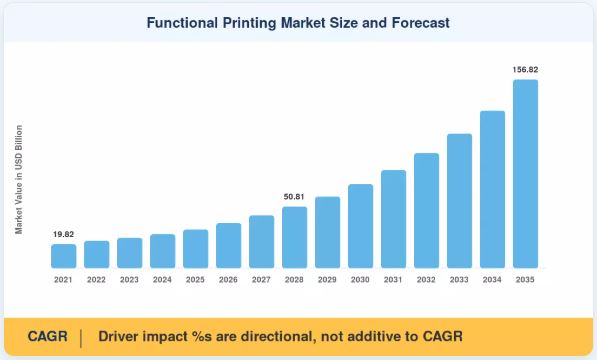
TOKYO, TOKYO, JAPAN, July 31, 2026 /EINPresswire.com/ -- The Global Functional Printing market reached an estimated USD 31.64 billion in 2025 and is projected to open the forecast window at roughly USD 37.05 billion in 2026, climbing to USD 156.82 billion by 2035 at a CAGR of 17.10%. Two catalysts anchor this trajectory: sustained capital flowing into silver nanowire capacity expansion, and procurement mandates from automotive OEMs adopting in-mould electronics for cabin sensing. The Functional Printing Market sits at the intersection of materials science and high-volume manufacturing, where falling line-width thresholds now make printed circuits commercially viable for everyday products, with flexible electronics adoption in automotive, conductive ink cost reduction, and roll-to-roll capacity expansion in Asia-Pacific standing out as the highest-impact growth drivers.— Market Research Future (MRFR)
Legacy rigid silicon assemblies and etched copper boards are steadily ceding ground to additive deposition on flexible substrates. Conductive ink chemistry has pushed achievable line widths below 10 µm, allowing roll-to-roll lines to produce sensors, antennas, and power films at a fraction of conventional tooling cost, and a reported USD 1.4 billion in cumulative venture and corporate investment into printed-electronics startups since 2022 underscores how quickly the supply base is scaling toward mass production.
North America leads the Functional Printing Market with a 30.1% share in 2025, while Asia-Pacific is the fastest-growing region at a 19.6% CAGR, propelled by display and smart-label fabrication clusters. Europe holds second position, anchored by stringent packaging sustainability rules that favor printed indicators over electronic alternatives. The decade ahead will reward producers who marry recyclable substrates with reliable high-throughput deposition.
Get Full PDF Sample Copy of Report: (Including Full TOC, List of Tables & Figures, Chart) @
https://www.marketresearchfuture.com/sample_request/7978
➤ How Significant Is the Functional Printing Market's Growth?
The functional printing market's trajectory from USD 31.64 billion in 2025 to a projected USD 156.82 billion by 2035 represents nearly a five-fold expansion over the forecast decade, reflecting the structural shift from rigid silicon assemblies and etched copper boards toward additive deposition on flexible substrates as a mainstream manufacturing approach across sensors, displays, and connected packaging. The market's 17.10% CAGR is anchored in falling line-width thresholds and cost curves that are making printed electronics commercially viable well beyond their original niche in prototyping and short-run production.
Inkjet printing held a 35.6% share of 2025 revenue, reflecting its precision advantage in low-volume, high-mix runs, while nanoparticle-based inks are advancing at a 20.4% CAGR through 2035, the fastest among ink categories, prized for the sub-10-µm resolution that unlocks denser, higher-performance printed devices. Sensor applications generated approximately USD 7.9 billion in 2025 demand, spanning automotive, industrial, and medical use cases, while RFID tag/NFC tag applications show the fastest application CAGR at 18.3% as supply-chain visibility and anti-counterfeiting needs intensify across global trade. North America commanded a 30.1% share of the market in 2025, while Asia-Pacific posts the leading regional CAGR at 19.6%, propelled by concentrated display fabrication and aggressive roll-to-roll buildout.
➤ What Does the Future Hold for the Functional Printing Market?
Flexible electronics adoption in automotive is one of the highest-impact drivers of the functional printing market. To reduce weight and wiring complexity, automakers are incorporating printed sensors and in-mould touch surfaces into dashboards and door panels, and tier-one suppliers have committed more than USD 600 million to printed-electronics tooling since 2023 as the EU's General Safety Regulation requires improved occupant-detection systems, accelerating printed-sensor integration across vehicle platforms.
Conductive ink cost reduction is a second major driver: silver nanoparticle and silver nanowire inks have seen formulation costs fall by roughly 28% over three years as feedstock recycling and alternative chemistries mature, a decline that has moved unit economics decisively in favor of additive deposition for antennas and heater films and broadened the addressable application base. Roll-to-roll capacity expansion is accelerating adoption for smart labels and diagnostic patches, where high-throughput processes shorten regional supply chains and lower fabrication costs per unit more than USD 450 million in pilot-to-production line conversions have been supported by public-private initiatives across Asia-Pacific, closing the gap between prototype and commercial volume.
The next phase of growth is being shaped by AI-driven process control, as machine-vision and AI defect-detection systems enter roll-to-roll lines and raise yields on sub-10-µm prints that were previously uneconomic. As inline analytics mature and scrap rates fall, high-volume printed electronics are becoming viable for cost-sensitive consumer goods, while the broader electrification supercycle multiplies demand for lightweight printed sensors and antennas in EVs, grids, and IoT nodes.
Get access to the full description of the report @
https://www.marketresearchfuture.com/reports/functional-printing-market-7978
➤ Who Are the Key Players in the Functional Printing Market?
The functional printing market is moderately fragmented, with an estimated Herfindahl-Hirschman Index below 900 and a top-five combined share near 38%. No single player dominates; competition turns on materials, IP, deposition precision, and substrate partnerships, keeping specialist ink chemists and diversified industrial-printing conglomerates on relatively even footing. MRFR identifies the following key participants with estimated revenue share ranges:
E Ink Holdings (~8–11% share) - the display technology leader providing display films and e-paper, with a deep installed base across e-readers and low-power signage applications.
Molex, a Koch company (~7–10% share) - an interconnect integration specialist providing printed circuits and antennas, leveraging its broader connector business to serve automotive and consumer electronics OEMs.
DuPont (~6–9% share) - a materials-breadth leader supplying conductive inks and functional materials, with a portfolio spanning multiple substrate and ink chemistries used across the industry.
Optomec (~5–8% share) - a precision deposition specialist providing aerosol jet printing systems for fine-feature electronics and 3D-conformal circuits.
Novacentrix (~4–7% share) - a sintering innovation leader offering inks and photonic curing systems that enable low-temperature processing on heat-sensitive substrates.
BASF (~4–7% share) - a chemicals-scale provider of functional materials, supplying formulation inputs across the conductive and dielectric ink value chain.
Agfa-Gevaert (~3–6% share) - an imaging-heritage specialist offering conductive inks and films, applying decades of coating expertise to functional printing substrates.
Nissha (~3–6% share) - an automotive sensing specialist providing printed sensors and in-mould electronics for cabin and touch-surface applications.
Thinfilm Electronics (~2–5% share) - a connected-packaging specialist providing NFC tags and printed memory, positioned at the center of the smart-label and brand-authentication opportunity.
Eastman Kodak (~2–5% share) - an equipment-legacy provider of printing systems and inks, applying its imaging and coating heritage to functional-printing production lines.
Strategic competition in the functional printing market is increasingly defined by silver-reduction roadmaps and feedstock hedging, proprietary low-temperature ink chemistry, substrate-recyclability credentials, and the depth of co-design partnerships between ink, substrate, and equipment suppliers.
➤ What Are the Emerging Trends in the Functional Printing Market?
Several transformational trends are redefining the functional printing market's evolution through 2035:
AI-Driven Process Control: Machine-vision and AI defect-detection systems are entering roll-to-roll lines, raising yields on sub-10-µm prints that were previously uneconomic. As inline analytics mature, scrap rates fall, and high-volume printed electronics become viable for cost-sensitive consumer goods.
Platform Economics of Connected Packaging: Printed NFC and RFID transform packaging into a recurring data platform rather than a one-time consumable. Brands increasingly value the post-purchase engagement layer, reshaping how printed-electronics value is captured across the supply chain.
Sustainability and Substrate Transition: With global e-waste exceeding 60 million tonnes annually, recyclable paper and ceramic substrates are gaining regulatory and reputational pull, and producers that certify circularity are positioned to win packaging contracts as ESG reporting requirements tighten.
Electrification and Distributed Sensing: The broader electrification supercycle is multiplying demand for lightweight printed sensors and antennas in EVs, grids, and IoT nodes, expanding the addressable base for printed power-management and sensing films as clean-energy capital accelerates.
Printed Diagnostic Wearables: Inexpensive printed biosensors on skin-conformal substrates are opening a high-margin avenue in point-of-care diagnostics, where single-use patches monitor glucose, hydration, and cardiac signals one of the decade's most resilient demand pools given aging-population health spending.
Emerging-Market Smart Labels: Rising e-commerce volumes across India, Southeast Asia, and Latin America are creating headroom for printed RFID and NFC labels in logistics and anti-counterfeiting, with local roll-to-roll capacity reducing import dependence and positioning emerging markets as both producers and consumers.
Buy Full Research Report:
https://www.marketresearchfuture.com/checkout?currency=one_user-USD&report_id=7978
➤ How Is the Functional Printing Market Segmented?
The functional printing market report provides a comprehensive segmentation framework:
By Substrate: Plastic Films (50.4% share, 2025), Paper and Paperboard (USD 6.8 Billion, 2025), Glass (12.1% share), Others (14.0% CAGR)
By Ink Type: Conductive Inks (USD 14.2 Billion, 2025), Nanoparticle-based Inks (20.4% CAGR), Dielectric & Insulating Inks (18.3% share), Others (9.5% share)
By Printing Technology: Inkjet (35.6% share, 2025), Screen (USD 9.1 Billion, 2025), Gravure (16.8% share), Flexography (13.4% CAGR)
By Application: Sensors (USD 7.9 Billion, 2025), RFID/NFC Tags (18.3% CAGR), Displays (21.5% share), OLED Lighting Panels (11.2% share)
By Region: North America (30.1%), Europe (26.4%), Asia-Pacific (19.6% CAGR), South America (USD 1.9 Billion), Middle East & Africa (USD 1.4 Billion)
➤ What Are the Regional Insights from the Functional Printing Market?
North America leads the functional printing market with a 30.1% share in 2025, with the United States commanding roughly 78% of regional revenue through a dense ecosystem of automotive tier-ones and medical-device firms adopting printed sensors at scale. US federal advanced-manufacturing grants and a deep venture base keep the region at the technology frontier, Canada contributes about 14% of regional share through flexible display R&D, and Mexico anchors lower-cost assembly with roughly 8% of regional revenue.
Europe holds the second-largest share at 26.4% of global revenue, with its trajectory shaped by packaging sustainability directives that reward printed indicators and recyclable substrates. Germany commands approximately 28% of regional revenue through industrial sensing applications, the UK contributes 16% through printed display research, and France, Italy, Spain, and the Nordic countries round out the region through packaging electronics, smart labels, retail tagging, and diagnostics respectively. Germany's industrial-sensor base and Nordic diagnostic startups give the region a balanced, regulation-driven demand profile.
Asia-Pacific is the fastest-growing region at a 19.6% CAGR, with its status stemming from concentrated display fabrication and aggressive roll-to-roll buildout in China, Japan, and South Korea. China commands approximately 42% of regional revenue through display and label fabrication, Japan contributes 18% through advanced inks, South Korea adds 13% through OLED and flexible-display manufacturing, and India is expanding through smart packaging demand at roughly 14% of regional share. Government industrial programs subsidize line conversions across the region, compressing time-to-volume for printed components.
South America and the Middle East & Africa remain smaller but developing regions for the functional printing market. Brazil dominates South American demand as e-commerce logistics adopt printed tracking labels, though currency volatility and import dependence temper growth even as local converters begin to add capacity. In the Middle East & Africa, Gulf retail modernization and anti-counterfeiting initiatives are driving early adoption of printed tags, with Saudi Arabia and the UAE leading regional demand through retail, logistics, and authentication use cases, while South Africa and Egypt represent the region's next wave of adoption as logistics-hub investments expand.
➤➤➤ Regional & Country-Level Reports by Market Research Future:
US Functional Printing Market -
https://www.marketresearchfuture.com/reports/us-functional-printing-market-16773
➤➤➤ Related Reports by Market Research Future:
Professional Headset Market
https://www.marketresearchfuture.com/reports/professional-headset-market-42681
Powder Bed Fusion Process 3D Printer Market
https://www.marketresearchfuture.com/reports/powder-bed-fusion-process-3d-printer-market-42687
Inductive And Lvdt Sensor Market
https://www.marketresearchfuture.com/reports/inductive-lvdt-sensor-market-42696
Active Passive Electronic Components Market
https://www.marketresearchfuture.com/reports/active-passive-electronic-components-market-42712
Hazardous Waste Handling Automation Market
https://www.marketresearchfuture.com/reports/hazardous-waste-handling-automation-market-42716
Lab Automation In Genomic Market
https://www.marketresearchfuture.com/reports/lab-automation-in-genomic-market-42737
Logic Ic Market
https://www.marketresearchfuture.com/reports/logic-ic-market-42790
Semiconductor Wet Etch System Market
https://www.marketresearchfuture.com/reports/semiconductor-wet-etch-system-market-42798
Smartphone Camera Lens Market
https://www.marketresearchfuture.com/reports/smartphone-camera-lens-market-42807
Material Jetting Process 3D Printing Market
https://www.marketresearchfuture.com/reports/material-jetting-process-3d-printing-market-42811
Sagar Kadam
Market Research Future
+ + +1 628-258-0071
email us here
Legal Disclaimer:
EIN Presswire provides this news content "as is" without warranty of any kind. We do not accept any responsibility or liability for the accuracy, content, images, videos, licenses, completeness, legality, or reliability of the information contained in this article. If you have any complaints or copyright issues related to this article, kindly contact the author above.
