

China-aided Laos’ first integrated photovoltaic-storage-charging “zero-carbon library” opens
HANGZHOU, China, Sept. 02, 2026 (GLOBE NEWSWIRE) -- Laos’ first zero-carbon library, built with support from Zhejiang Electric Power Corporation, officially opened at Luang Prabang Peace Secondary School on August 29. The library integrates solar power, energy storage and charging facilities, bringing a green energy solution to the school.
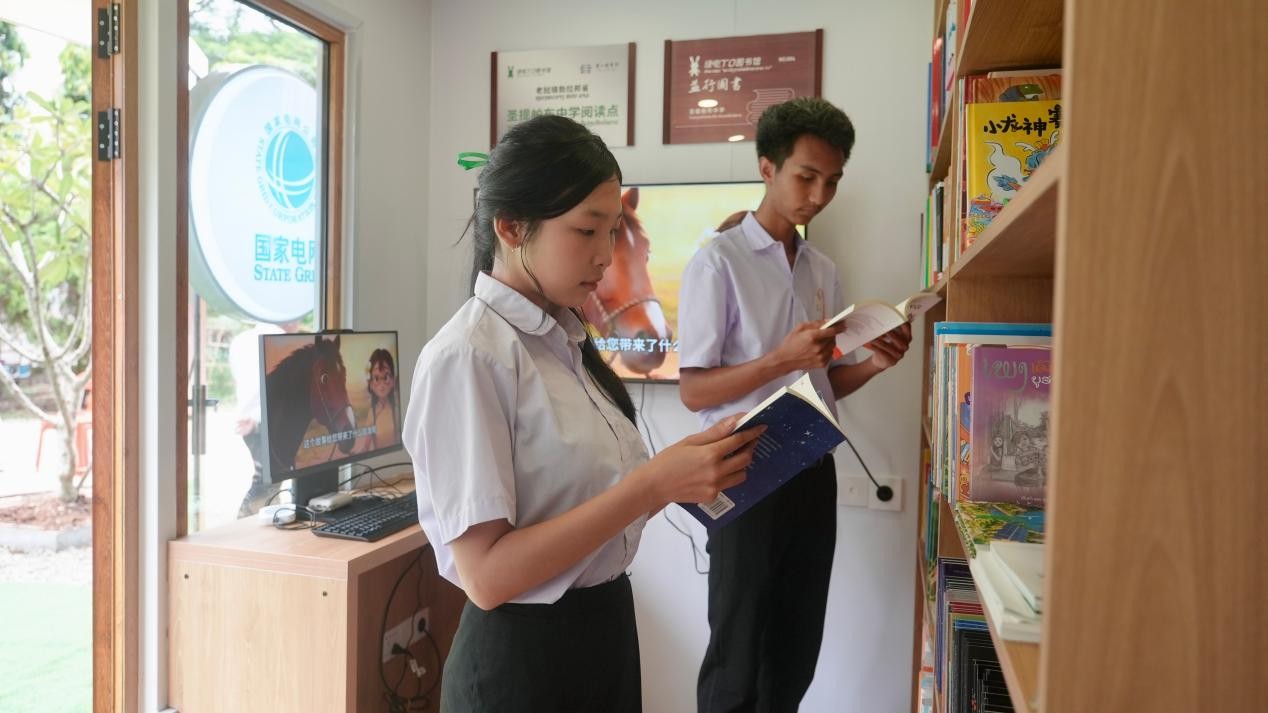
This "green gift" from Zhejiang also carries special significance, coming in the 65th anniversary year of China-Laos diplomatic relations and the jointly declared "China-Laos Friendship Year." In June, Thongloun Sisoulith, General Secretary of the Lao People's Revolutionary Party and President of Laos, visited China, with his first stop in Zhejiang, where both sides reached a series of agreements on deepening a China-Laos community with a shared future. Two months later, those agreements took root along the Mekong River in the form of a library.
Inside, the outdoor heat gives way to cool air, with computers, televisions, bookshelves and Chinese-Lao bilingual books neatly arranged. Students can browse books, search the digital library, and study independently in a quiet, comfortable environment.
"Since the China-Laos Railway opened, we have been exposed to many new things—concepts like artificial intelligence and the digital economy that we rarely heard of before. We are still students with few opportunities to go out, so reading has become our only way to broaden our horizons and gain knowledge," said Zalen, a second-year student at Luang Prabang Peace High School.
However, local extracurricular reading resources are scarce; to find books beyond their textbooks, students often had to travel by train more than 200 kilometers to Vientiane, the capital—a two-and-a-half-hour journey one way. "Now the library is right outside the classroom. There are many books I want to read here, and there's air conditioning too. It feels especially convenient and comfortable," Zalen said.
Principal Bounkham Vansy believes that this library is not just a reading room, but also a new channel connecting to the outside world. "This is another passage to the outside world after the China-Laos Railway, a path for students to gain new knowledge and ideas. The school will make good use of this library and manage it well, so that it can truly be integrated into daily teaching, provide students with more opportunities to learn and grow, and realize its greatest value," he said.
Laos relies heavily on hydropower, and seasonal changes in water flow put pressure on the power supply during the dry season. Luang Prabang, in northern Laos, also has limited grid infrastructure in some areas, adding to the school's electricity challenges.
Since upgrading the main power grid was difficult to achieve in the short term, a microgrid solution was adopted. The "Green Energy TO" public welfare team of State Grid Zhejiang Electric Power Co., Ltd. decided to use China's mature integrated photovoltaic-storage-charging microgrid technology. The library was manufactured in factories in Zhejiang in the form of prefabricated cabins and completed in Laos in just four days.
During the day, rooftop photovoltaic panels generate electricity, storing surplus power in an energy storage system that releases it at night to provide the library a stable energy supply.
On the same day, an "Air Classroom" was also launched together with the library. When the big screen lit up, Luang Prabang Peace Secondary School on one side and Gaoqiao Junior High School in Xiaoshan District, Hangzhou, Zhejiang, on the other, "met" across a distance of 5,000 li.
Chinese teachers introduced Lao students to Chinese culture and science through the screen. Zero-carbon engineer Lai Hanbin gave the children a lesson on new-type power systems, and volunteers from State Grid Zhejiang Electric Power Co., Ltd. helped the children assemble a robot dog, drawing cheers as it walked across the lawn. Lao students in turn, shared their own culture, introducing the Lao New Year — the Water Splashing Festival.
The most popular attraction was the UN Sustainable Development Goals science base beside the library. Students pedaled vigorously on power-generating bicycles, cheering. Looking at the photovoltaic panels and photovoltaic benches, the students said, "So this is green, low-carbon, and sustainable development!"
"We have innovated a public welfare service model of 'new energy + new education', using green energy to support remote education and interactive learning to spread the concept of green and low-carbon development," said Zhang Jun, head of the "Green Energy TO" public welfare team of State Grid Zhejiang Electric Power Co., Ltd. "In the future, the library will join hands with the Zhejiang Provincial Science Popularization Association, the Abin Volunteer Service Center of State Grid Hangzhou Power Supply Company, and Xiaoshan District Library of Hangzhou to provide children on both sides with 21 class hours of air classes across five dimensions, including natural science and traditional culture."
From reading to classes, from online exchanges to hands-on experience, the library, the classroom and the science base are now connected—turning green energy into an everyday campus experience that students can read, discuss and practice.
"This is a green practice that crosses mountains and seas," said Khamla Lianbadi, deputy secretary of the Luang Prabang Provincial Party Committee. "It has not only brought advanced power grid technology to Laos, but also sowed the development philosophy of 'lucid waters and lush mountains are invaluable assets' and the beautiful ideal of jointly building a clean and beautiful world on this land."
At the unveiling ceremony, representatives from both China and Laos also jointly planted a Champa tree, the national tree of Laos. A sapling has taken root, and a library has lit up dreams. From Zhejiang to Luang Prabang, this scent of books crossing mountains and seas is witnessing the China-Laos community with a shared future being continuously deepened and consolidated. (Luo Zhen, Zhu Xiaowei)
Company: Zhejiang Electric Power Corporation
Contact Person: Zhen Luo
Email: gwhzgdgs@zj.sgcc.com.cn
Website: www.zj.sgcc.com.cn
City: Hangzhou
A photo accompanying this announcement is available at https://www.globenewswire.com/NewsRoom/AttachmentNg/17206f4a-9be7-45d4-b965-fa29e2d138f7

China-aided Laos’ first integrated photovoltaic-storage-charging “zero-carbon library” opens
China-aided Laos’ first integrated photovoltaic-storage-charging “zero-carbon library” opens
Legal Disclaimer:
EIN Presswire provides this news content "as is" without warranty of any kind. We do not accept any responsibility or liability for the accuracy, content, images, videos, licenses, completeness, legality, or reliability of the information contained in this article. If you have any complaints or copyright issues related to this article, kindly contact the author above.
