

Korea F-2 to F-5: Compliance Requirements and Key Reviews

Establishing long-term residency in South Korea through F-2 and F-5 visas allows foreign investors and professionals to seamlessly integrate into vibrant local communities and commercial hubs.
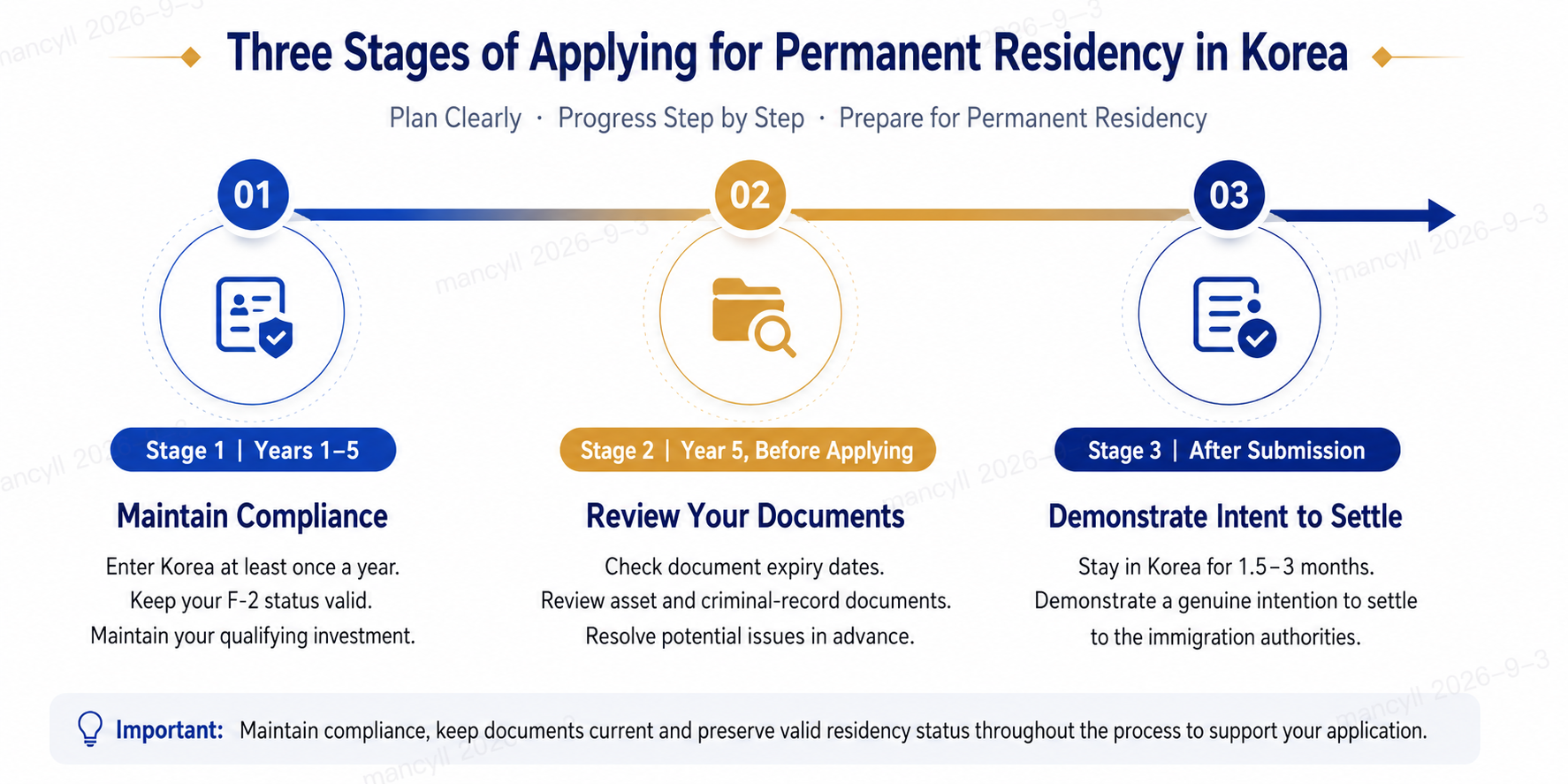
Successfully transitioning from a South Korea F-2 visa to F-5 permanent residency requires strict adherence to a multi-year compliance cycle, continuous investment maintenance, and thorough document preparation.
Globevisa Group explains the latest compliance requirements, investment rules, and residency conditions for the South Korea F-2 to F-5 permanent residency path.
SG, SINGAPORE, September 4, 2026 /EINPresswire.com/ -- The South Korean F-2 residency status covers various categories, including investment and talent. The requirements and required residency periods for transitioning from different F-2 categories to the F-5 permanent residency are not uniform. For investment-based F-2 visas, certain pathways require maintaining the investment for over five years. For the points-based F-2-7 visa, there is a pathway to apply for a points-based F-5 permanent residency after three years. Based on South Korean immigration regulations and case experience, Globevisa Group outlines the residency, investment, and application requirements involved in transitioning from an F-2 to an F-5 visa.
Statutory Admission Pathways for South Korea F-2 Residency
The South Korea F-2 visa allows the main applicant, their spouse, and unmarried eligible children to apply together. Provided the original application conditions are maintained and there is no record of violations, this visa offers a stable renewal mechanism. Currently, the primary compliant pathways to obtain an F-2 visa include the following three categories:
●Real Estate Investment (F-2-8): Applicants invest in real estate projects specified by the South Korean Ministry of Justice to apply for F-2 residency. For eligible real estate investors, maintaining the investment for over five years allows them to apply for the corresponding F-5 permanent residency.
●Public Business Investment Deposit (F-2-12): Applicants deposit funds into eligible public business investment projects as stipulated by the Ministry of Justice. The principal-guaranteed, zero-interest investment option is operated by the Korea Development Bank (KDB) through related public funds. Investors who meet the conditions and maintain their investment for over five years can apply for the corresponding F-5 permanent residency.
●Points-Based Visa for Outstanding Talent (F-2-7): Targeting eligible foreign professionals, South Korea evaluates applicants based on age, education, Korean language proficiency, and income. Applicants must reach the required score while fulfilling good conduct, employment activity, and other related criteria.
Key Review Areas for Transitioning from F-2 to F-5 Permanent Residency
The specific requirements for transitioning from F-2 to F-5 depend on the F-2 category and its corresponding F-5 type. According to current data from the Ministry of Justice, the general permanent residency pathway applies to applicants who have resided in South Korea for over five years under D-7 to D-10, E-1 to E-7, or F-2 status. For outstanding talent under the points system, a pathway exists to apply for the points-based F-5 after residing under F-2-7 status for over three years. For investment-based F-2 visas, maintaining the stipulated investment status for over five years is typically a primary condition.
1.Residency Records and Application Conditions
For F-5 applications based on residency duration in South Korea, applicants must meet the specified residency period for their respective category and provide related residency records. The "one-year" period in South Korea's current re-entry regulations primarily refers to the re-entry permit exemption period for registered foreigners. This means an F-2 visa holder must enter South Korea at least once every 365 days; the time between departure in the previous year and entry in the following year must not exceed one year (applicable to any region in South Korea).
Therefore, before applying for the F-5 visa, applicants should verify their F-2 card holding period, immigration records, and other requirements based on their specific category, rather than relying solely on a single or short-term entry record to determine residency compliance.
2.Continuous Maintenance of Investment Status
For investment-based F-2 visas, the F-5 application is directly tied to the continuous maintenance of the investment. The Ministry of Justice requires real estate investors, general public business investors, and related investors to maintain their stipulated investments for over five years, alongside meeting other conditions.
Consequently, if any asset changes occur during the F-2 holding period—such as sales, mortgages, early return of principal, or other actions that may affect investment conditions—they must be reviewed against the specific investment category and relevant regulations. For public business investments, the Ministry of Justice explicitly states that after meeting the five-year investment maintenance requirement, the investment principal can be returned according to the respective institutional arrangements.
Globevisa Group's Long-Term Compliance Management Practices
The management cycle for transitioning from F-2 to F-5 can span several years. According to Globevisa Group, its related services include pre-application document review, status management during the holding period, and document preparation and local assistance during the F-5 application stage.
●Pre-Application Compliance Review: Globevisa Group states that it maintains an internal bilingual (Chinese-Korean) legal team that conducts compliance reviews of applicants' education, income, tax records, and other application documents prior to submission. For the F-2-7 points-based program, this primarily involves verifying the consistency between scoring items, income proofs, and supporting materials.
●Continuous Management During the Holding Period: Based on case data provided by Globevisa Group, the agency has provided F-2 related services to over 1,300 families. It conducts regular management of assets and residency matters during the holding period, including verifying investment accounts or property rights certificates, and reminding applicants of residency card renewals and travel arrangements. This management helps applicants consistently meet original residency conditions and reduces compliance issues caused by missing information or improper handling.
●Post-F-5 Application Procedures: Globevisa Group notes that its local teams in Seoul and Jeju provide administrative assistance, including dedicated vehicle escorts, currency exchange guidance, and fingerprint registration. For applicants who have obtained F-5 permanent residency, the agency further assists with post-approval matters, such as the return of investment principal in accordance with relevant regulations. According to its data, nearly 100 client families have completed the transition from F-2 to F-5 status.
Conclusion
The transition from a South Korean F-2 to an F-5 visa is not a uniform five-year path for all applicants. Applicants must first identify their specific F-2 category and the corresponding F-5 application type, then monitor residency periods, investment maintenance, income, conduct, and other requirements based on applicable regulations. For investment-based F-2 visas, continuously maintaining the investment status is a critical application condition. For talent categories like the F-2-7, applicants should focus on the corresponding residency period and application criteria.
For applications involving a multi-year residency cycle, promptly retaining records related to immigration, investment, and identity status is essential for accurately verifying relevant conditions in subsequent application stages.
About Globevisa Group
Headquartered in Singapore since 2002, Globevisa Group is a global HNWI wealth management and cross-border identity advisory firm. Backed by institutional-grade risk control, the firm operates 50+ direct branches globally with over 800 in-house professionals. Having processed 120,000+ cases for clients across 120+ countries, Globevisa specializes in citizenship planning, wealth management, and family relocation, empowering international families to achieve barrier-free global settlement.
Globevisa Group Team
Globevisa Group
email us here
Visit us on social media:
LinkedIn
Instagram
Facebook
YouTube
TikTok
X
Legal Disclaimer:
EIN Presswire provides this news content "as is" without warranty of any kind. We do not accept any responsibility or liability for the accuracy, content, images, videos, licenses, completeness, legality, or reliability of the information contained in this article. If you have any complaints or copyright issues related to this article, kindly contact the author above.
