

Finger Bridge Highlights Institutional Connectivity as SEC Framework Opens a New Path for Tokenized Securities
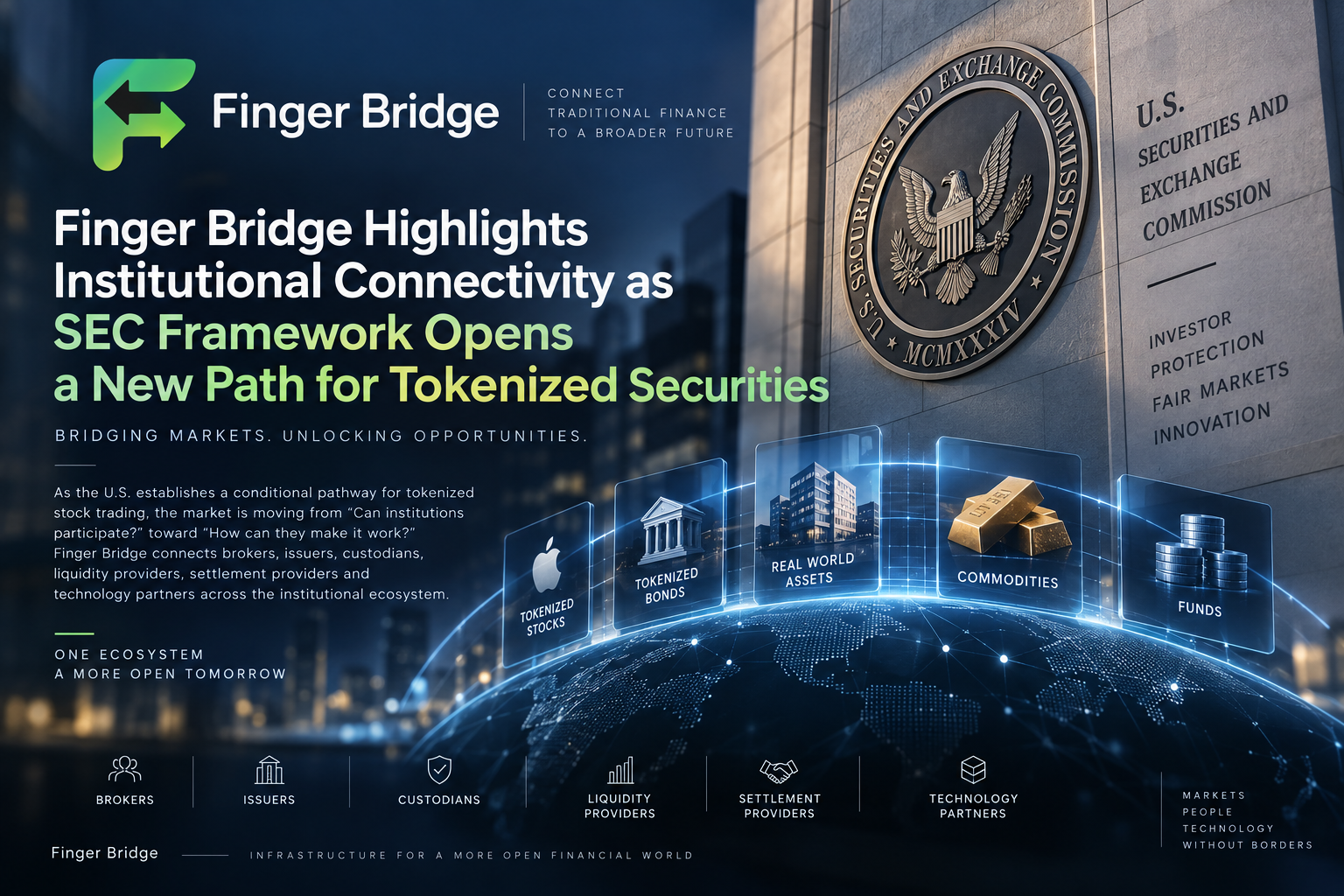
As U.S. rules open a path for tokenized stocks, Finger Bridge connects brokers, issuers, custodians and technology partners across the ecosystem.
OSAKA, JAPAN, September 17, 2026 /EINPresswire.com/ -- The U.S. Securities and Exchange Commission (SEC) on September 17 issued an “Innovation Exemption,” providing temporary, conditional exemptive relief for qualifying Tokenized Securities Venues (TSVs) to facilitate on-chain trading of certain tokenized U.S. National Market System (NMS) stocks through permissioned automated market makers and liquidity pools.The measure does not represent a broad opening of tokenized stock trading. Instead, it establishes a defined experimental pathway subject to specific limitations and investor-protection conditions.
Under the SEC framework, tokenized NMS stocks must provide holders with the same rights and privileges as the corresponding class of traditional NMS stock. Where tokenization is carried out by an unaffiliated third party, the issuer of the underlying stock must receive prior notice and an opportunity to object. Smart contracts used by a TSV must be public and auditable and deployed on a public, permissionless distributed ledger. Trading in a tokenized NMS stock must also halt when trading in its underlying stock is halted on the primary listing exchange.
The exemptions are scheduled to expire five years after publication. The SEC is also seeking public comment on potential modifications and next steps as it gathers operational experience from the market.
As the Regulatory Path Becomes Clearer, the Next Question Is How to Build
For financial institutions exploring tokenized securities, greater regulatory clarity is only the beginning.
Building an operational business model may still require capabilities across issuance and tokenization, brokerage, custody, liquidity, settlement and reconciliation, as well as technology and operational services.
Institutions considering this market therefore face several practical questions early in the process:
What role should we play? What capabilities are still missing? Which institutions can provide them? How do we establish those relationships? And once a relationship is established, how do the processes and systems connect?
This highlights a fundamental reality of tokenized markets:
Tokenization may change the technological form of assets and trading, but it does not eliminate the division of responsibilities and the need for collaboration among financial institutions.
As the market moves from policy exploration toward practical validation, institutional connectivity itself becomes part of the infrastructure challenge.
Finger Bridge: Understanding Who Can Do What
Finger Bridge, developed by Japan-based Sargia Inc. as part of the Finger Grid ecosystem, is infrastructure for institutional discovery, connectivity and cross-institutional collaboration.
At its simplest, the first layer of Finger Bridge can be understood as an institutional directory for financial markets.
But the objective goes beyond identifying who is in the market.
The more important question is:
What can each institution actually provide?
Institutions joining Finger Bridge can present their market role and available business capabilities. Other participants can search according to their own requirements, understand the capabilities offered by relevant institutions, and submit a connection or collaboration request directly to them.
An institution exploring tokenized securities, for example, may need to identify participants with capabilities in issuance and tokenization, brokerage, custody, liquidity, settlement, reconciliation, technology or other required services.
At the same time, institutions that already provide these capabilities can make it easier for potential counterparties to understand who they are and what they can offer.
Finger Bridge structures and aggregates this information and provides the connection layer, but it does not make commercial decisions on behalf of participating institutions.
Whether to accept a request, establish a relationship or provide a particular service remains entirely with the institutions involved.
Finding the Right Institution Is Only the Beginning
A traditional directory has largely completed its role once the right organization has been found. In financial markets, that is often where the real work begins.
Once institutions decide to collaborate, they may still need to define roles and responsibilities, manage approval processes, coordinate workflow stages, exchange status information, and integrate APIs and external systems.
Finger Bridge therefore extends institutional discovery into an ongoing collaboration process:
Institution Discovery → Capability Identification → Collaboration Request → Institutional Approval → Connection → Workflow Coordination → Status Tracking → System Integration
Throughout this process, participating institutions retain control over their own systems, commercial decisions and regulatory responsibilities.
Finger Bridge does not connect a financial product. It connects the institutions required to make that financial product possible.
Finger Bridge does not issue securities, provide brokerage services, perform custody or settlement, or replace a trading venue. Its role is to address the recurring connectivity and coordination challenges between different market participants.
New Markets Require More Than New Trading Technology
The SEC’s latest measure provides a new practical use case for this type of institutional connectivity.
As more market participants begin evaluating tokenized NMS stocks, the market may increasingly contain two complementary groups: institutions looking for capabilities and institutions that already provide those capabilities and are looking to establish new relationships.
Finger Bridge is designed to connect these two sides.
Institutions seeking capabilities can identify potential counterparties, while institutions providing those capabilities can make their services more discoverable to the market.
Both sides can discover one another and initiate a connection through Finger Bridge, while the decision to establish an actual business relationship remains with the participating institutions.
Sargia provides the connectivity and collaboration infrastructure. The underlying financial services continue to be provided by the relevant market participants.
Institutions Do Not Need a Complete Model Before Starting the Conversation
Financial institutions exploring tokenized securities do not necessarily need to have a fully designed business model before beginning to engage with the market.
Institutions that are still determining their intended role, identifying missing capabilities, evaluating potential counterparties, or considering how external systems should connect can engage directly with the Sargia team.
Sargia will work with interested institutions to map practical business workflows and connectivity requirements, beginning with several basic questions:
What capabilities already exist internally? Which market roles are still required? Which functions require external institutional partners? What system and API connections are needed?
Once these requirements become clearer, relevant market participants can be identified and connected through Finger Bridge, followed where appropriate by technical and operational validation.
An initial discussion with Sargia does not require a system procurement decision or a fully defined project.
For institutions still at the research and architecture stage, the conversation can begin simply by identifying what is already in place — and what is still missing.
From Institutional Connectivity to System Validation
As an institution’s business architecture and partnership requirements become clearer, Sargia will also make relevant Finger Grid integration and testing environments available to financial institutions and technology partners exploring these models.
Finger Manager can be used to evaluate institution-side workflows involving orders, permissions, risk, operations and external system connectivity.
Where a project also requires validation of the connection between a trading interface and institutional systems, Finger Trader can form part of the testing environment.
Within the institutional exploration and validation process, the three components therefore serve distinct purposes:
Finger Bridge — identify and connect the institutional capabilities required to build the service
Finger Manager — validate institution-side operations and system connectivity
Finger Trader — where required, validate connectivity between the trading interface and institutional systems
These environments are intended for technical, system and operational workflow validation. They do not replace the regulated financial functions, commercial decisions or regulatory responsibilities of participating institutions.
Connecting Market Demand With Institutional Capabilities
As tokenized securities move from policy discussion toward practical market validation, Sargia aims to work with different market participants to better understand real-world institutional connectivity and system requirements.
Financial institutions exploring tokenized securities or related financial services — including those still identifying the partners, capabilities or technology architecture they may require — are welcome to engage with Sargia.
Institutions already providing capabilities in issuance and tokenization, brokerage, custody, liquidity, settlement, reconciliation, technology or related services are also welcome to join Finger Bridge, present their capabilities and become discoverable to potential institutional counterparties.
Assets can move on-chain, but financial markets still require institutions to work together to deliver a service.
Finger Bridge does not replace those institutions. It makes it easier for them to find one another, understand one another’s capabilities, and establish connections while retaining full control over their own partnership decisions.
About Finger Bridge
Finger Bridge is an institutional connectivity and collaboration infrastructure developed by Japan-based Sargia Inc. as part of the Finger Grid ecosystem.
Finger Bridge structures institutional roles, business capabilities and collaboration entry points so that market participants can discover relevant institutions based on actual requirements and initiate connection requests. Once participating institutions independently decide to establish a relationship, Finger Bridge can further support cross-institutional workflow coordination, status tracking and system integration.
Finger Bridge does not perform or replace securities issuance, brokerage, custody, settlement or other regulated financial functions carried out by participating institutions.
Frank
Financial Times
email us here
Visit us on social media:
YouTube
Legal Disclaimer:
EIN Presswire provides this news content "as is" without warranty of any kind. We do not accept any responsibility or liability for the accuracy, content, images, videos, licenses, completeness, legality, or reliability of the information contained in this article. If you have any complaints or copyright issues related to this article, kindly contact the author above.
